
We may earn money or products from the companies mentioned in this post.
The choice between these three devices comes down to money against manual handling and session time. The Ultima 9 is the lower-priced handheld comb, the Ultima 12 is a comb with a shorter listed session, and the LaserBand 82 is a band that you reposition on your head.
This buying analysis compares manufacturer specifications, instructions, purchase terms and published research checked November 24, 2026. It does not report hands-on testing or provide a personal treatment recommendation.
Quick answer: which model might suit you?
Ultima 9 Classic LaserComb: Suits you if price leads your decision and you are comfortable combing for as little as 11 minutes, three days a week.
Ultima 12 LaserComb: Suits you if you like the comb format and want a listed session of as little as 8 minutes.
LaserBand 82 ComfortFlex: Suits you if you would rather position a band than move a comb, and you want the shortest listed session of the three, at 90 seconds.
Session time reflects how each device is designed to be used. Nothing reviewed here shows that a shorter session produces better results, and this buying comparison does not establish a regrowth winner.
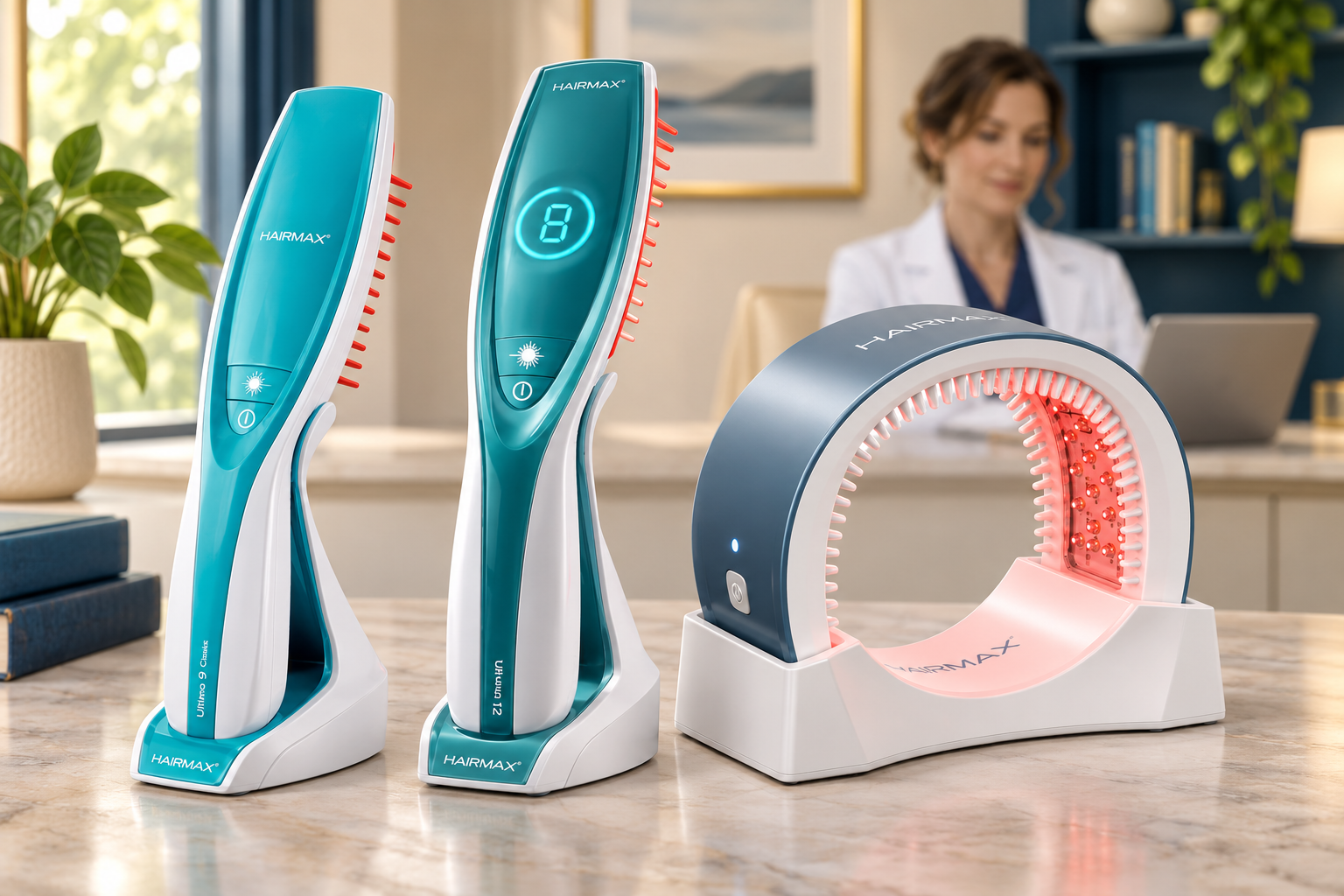
Side-by-side comparison
Session figures come from HairMax product pages observed November 24, 2026. They are manufacturer instructions, not independently measured treatment times.
| Feature | Ultima 9 Classic LaserComb | Ultima 12 LaserComb | LaserBand 82 ComfortFlex |
|---|---|---|---|
| Physical laser diodes | 9 | 12 | 82 |
| Handling and coverage | Handheld comb moved through hair | Handheld comb moved through hair | Band placed in three positions, at least 30 seconds in each per the instructions |
| Listed session and frequency | As little as 11 minutes, 3 days a week | As little as 8 minutes, 3 days a week | As little as 90 seconds, 3 days a week |
| Approximate weekly time* | About 33 minutes | About 24 minutes | About 4.5 minutes |
| Regular listed base price (USD)* | $249 | $399 | $849 |
| Direct-purchase guarantee | 6 months from purchase; 20% deduction plus return postage | Same direct-purchase terms | Same direct-purchase terms |
| Limited warranty | 1 year, qualifying US purchases | 1 year, qualifying US purchases | 1 year, qualifying US purchases |
*Weekly minutes are calculated from the listed session time multiplied by three, excluding setup, cleaning and charging. Base prices were checked on HairMax’s US pages November 24, 2026, without coupons, gifts or seasonal discounts. Tax and any checkout charges are additional.
The band’s 90 seconds equals three positions at the 30-second minimum.
HairMax Ultima 9 Classic LaserComb
The Ultima 9 has nine laser diodes and is the lower-priced handheld comb in this group. It carries the longest listed session of the three, at as little as 11 minutes, three days a week.
If you shop on price first, this is the model that sets the baseline the other two get measured against.
What the routine looks like
You hold the comb against your scalp and move it slowly through your hair in sections. The teeth are there to part the hair so the light can reach the scalp.
HairMax’s current quick-start guide specifies moving in approximately 1 cm steps with four-second pauses, following front-to-back and side-to-side passes for 11 minutes. Follow the guide rather than inventing a slower or longer routine.
Consider whether you can comfortably manage the required hand movement and follow the placement instructions. This is a practical question to assess before ordering; we have not measured comfort or fatigue.
Practical pros and cons
Pros: Familiar comb shape, direct control over which areas you work on, and the lower price point among the three.
Cons: The most weekly time of the three, and the routine depends on careful, consistent hand movement.
HairMax Ultima 12 LaserComb
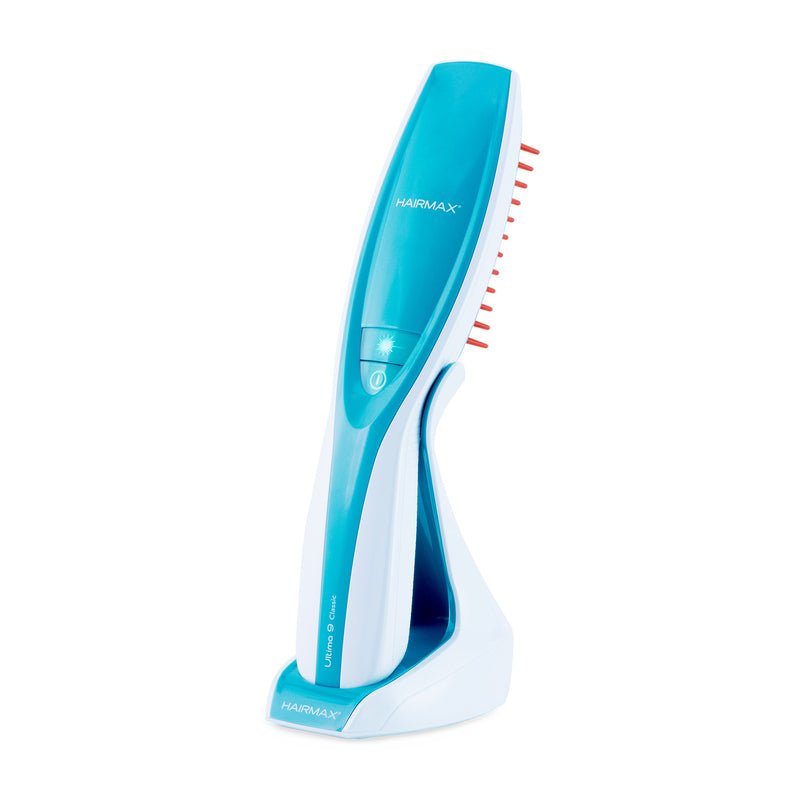
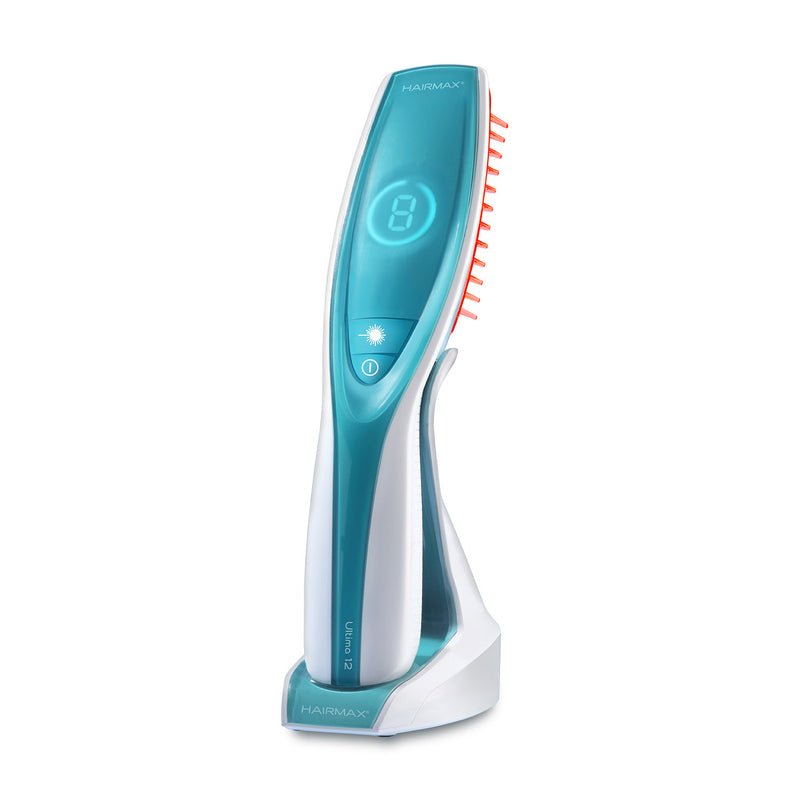
The Ultima 12 has twelve laser diodes and lists a session of as little as 8 minutes, three days a week. Against the Ultima 9, that saves 3 minutes per session and about 9 minutes per week.
Weekly time falls from roughly 33 minutes to roughly 24.
What changes from the Ultima 9
The quick-start guide also calls for controlled front-to-back and side-to-side passes with four-second pauses, for eight minutes total. Similar handling requirements do not mean every construction or accessory detail is identical.
The change is a shorter session, which can matter if you worry that you will skip sessions when they feel long.
A routine you keep up is worth more than a routine you abandon after a month.
What does not establish better regrowth
Three extra diodes and three fewer minutes say nothing about regrowth. The published comb research used older configurations, and the paper discussed below does not establish superiority of the current Ultima 12 over the current Ultima 9.
Treat the shorter session as a convenience feature.
At the checked base prices, the Ultima 12 costs $150 more. That buys a shorter listed comb session, not a demonstrated guarantee of better regrowth. Decide how much that convenience matters alongside the rest of the purchase terms.
HairMax LaserBand 82 ComfortFlex
The LaserBand 82 is a band that you position on your head. It is not a comb, and it is not a hands-free helmet.
It has 82 physical laser diodes.
HairMax describes coverage of 246 after repositioning. That figure comes from using three positions with 82 diodes.
The band does not contain 246 diodes.
Three-position handling
The instructions describe three positions, with a minimum of 30 seconds at each. That adds up to the 90-second listed session.
You place the band, wait for the cue and move it through the instructed positions. Its hair-parting teeth still need correct contact and placement. Avoid treating it as a helmet you can put on and ignore.
You still need to follow the manual for exact placement of each position, and you should confirm the current instructions on the product page.
Fit, teeth and portability
The band has its own fit requirements. It has to sit correctly on your head in each position, and head size and hair volume can affect that.
Check the sizing guidance on the product page before you buy.
Read the manual for details on any spacing features that help the light reach the scalp, and for how the device charges and stores. Do not assume one format is more portable without comparing its dimensions, charging equipment and protective storage.
Trade-offs
The band offers the shortest listed session of the three and removes the combing motion. Its three-position routine differs from the combs’ repeated passes; check that this handling works for you.
For a closer look at fit and day-to-day handling, read our HairMax LaserBand 82 ComfortFlex review.
Evidence and FDA indications
Three separate things tend to get blended together in this category: research by the brand, studies of older comb configurations, and the exact models on sale today.
The 2014 comb study
Jimenez and colleagues reported four randomized, double-blind, inactive-device-controlled trials involving 128 men and 141 women randomized to older 7-, 9- and 12-beam LaserComb configurations. Treatment lasted 26 weeks, three times weekly. The efficacy analysis included 103 men and 122 women after losses to follow-up.
Active groups had significantly greater increases in terminal hair density. No serious adverse events were reported. Lexington International partly funded the work, supplied equipment, and paid some authors as disclosed in the paper. These findings do not establish a current-model ranking or prove the LaserBand was tested; the band was not included.
The study used a limited age, skin-type and pattern-loss population. It does not guarantee an individual result or settle long-term outcomes. Older beam counts alone are insufficient to prove an exact match to today’s retail product.
What FDA clearance means
HairMax markets these products as FDA cleared. The 510(k) process assesses substantial equivalence, including intended use and safety/effectiveness questions; it differs from premarket approval and does not guarantee regrowth.
The FDA’s K142573 record names HairMax LaserComb 82 and 41; the manufacturer’s clearance history identifies the December 2014 band clearance. K103368 uses older comb names: Advanced 7, Lux 9 and Professional 12. Those historical names should not be silently substituted for current Ultima retail names.
Read the current model’s instructions and indications and ask HairMax to confirm its clearance mapping if the record uses a different name. Do not select suitability from the number of diodes or a brand-level clearance badge.
A word on lasers and LEDs
HairMax’s FAQ talks lasers and LEDs. That is a company position and does not establish that lasers outperform LEDs.
For background on the wider category, see our guide to red light therapy for hair loss.
Money details and returns
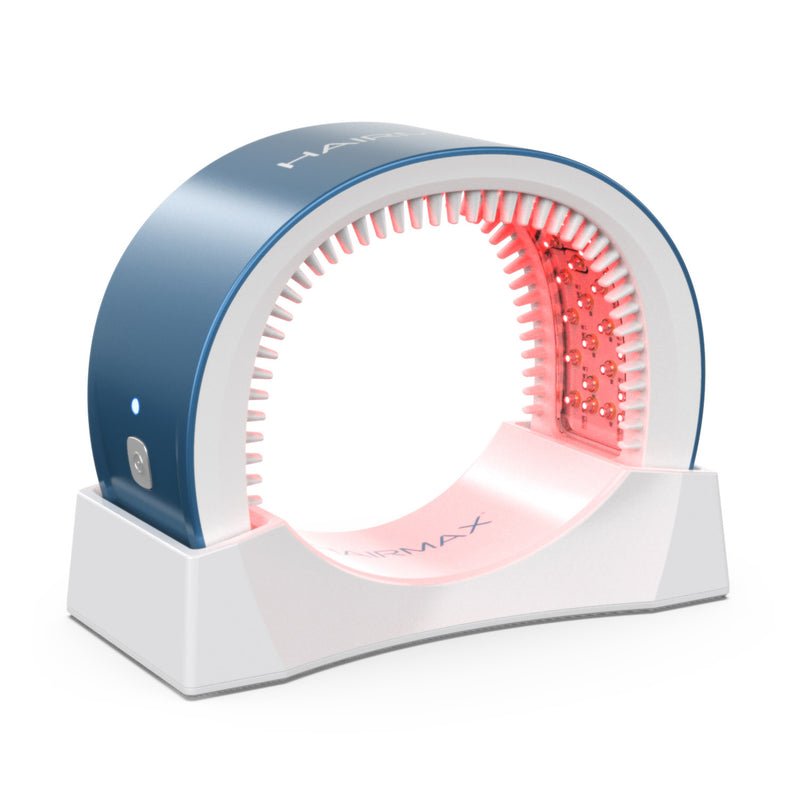
The regular listed prices are $249 for Ultima 9, $399 for Ultima 12 and $849 for LaserBand 82. Keep seasonal offers, accessories, financing and tax separate. The $600 difference between the band and Ultima 9 is a budget decision to weigh against handling and session time, not proof of better outcomes.
HairMax’s direct-purchase guarantee runs six months from original purchase. Its policy requires return authorization, customer-paid return postage and a 20% restocking deduction; original shipping and handling are nonrefundable. Keep proof of purchase and follow its RMA instructions. Third-party orders, including Amazon purchases, use the original seller’s return policy rather than this guarantee.
On a device-price-only calculation, the 20% deduction would be $49.80, $79.80 or $169.80 respectively at the listed base prices, before return postage. Actual refunds depend on the amount paid and applicable terms. A guarantee is therefore not a cost-free trial.
The separate one-year limited warranty covers manufacturing defects for qualifying original US end-user purchases from HairMax or an authorized seller. It starts at purchase or later delivery, excludes normal wear, misuse and specified damage, and requires contacting support for authorization. Covered claims use HairMax’s prepaid label. Keep the warranty distinct from a satisfaction return.
Safety and suitability
This comparison is for adult men considering devices for diagnosed pattern hair loss. A clinician can confirm that your hair loss is pattern hair loss, which matters because other causes call for different approaches.
Sudden shedding, patchy loss or scalp symptoms are good reasons to book an appointment first.
Talk to a clinician before starting if you have a scalp condition, a history of skin sensitivity to light, or a medical condition you think could be affected. Follow the model-specific manual for eye safety, usage and any listed precautions.
Short FAQs
Does a shorter session work better?
This comparison does not establish that. Session time is part of how each device is designed.
Does the LaserBand have 246 diodes?
No. It has 82 physical diodes. HairMax’s 246 figure refers to coverage after repositioning through three positions.
Were these exact models tested in the 2014 study?
The paper studied older 7-, 9- and 12-beam comb configurations. Mapping them to current models needs confirmation, and the band was not included.
Can I use a device alongside other treatments?
Ask your clinician. Keep any prescribed treatment as it is unless a clinician advises otherwise.
Does FDA clearance guarantee results?
No. Clearance reflects substantial equivalence. Results vary from person to person.
What is the biggest practical difference between the combs and the band?
The combs require hand movement through your hair for 8 to 11 minutes per session. The band needs placing and repositioning in three spots for as little as 90 seconds.
Practical conclusion
Choose the Ultima 9 if budget leads your decision and you can live with the longest session. Consider the Ultima 12 if a shorter comb routine justifies the verified $150 base-price increase for you.
Choose the LaserBand 82 if you want to avoid combing and have confirmed the fit and the current price.
If this is your first device, our first-time buyers guide to at-home laser hair growth devices covers the basics. Pick the routine you can realistically repeat three times a week for months, since regular use is what every one of these devices calls for.
Sources and scope
Checked November 24, 2026. Manufacturer session times and ordinary listed prices are distinguished from clinical results. Quick-start guides were checked; consult the full instructions supplied with your exact device before use. No firsthand testing or dermatologist review is claimed.