
We may earn money or products from the companies mentioned in this post.
Red light therapy for hair loss has clinical evidence behind some devices, but that does not make every glowing cap a sound purchase. For US men considering a home device, the useful questions are whether it fits the diagnosis, how closely its evidence matches the product, and what using and returning it will involve.
Quick answer: Some controlled trials support hair-growth benefits from specific light devices for androgenetic alopecia, or pattern hair loss. Results vary, and the evidence does not establish that any red lamp or helmet will work for you. Start with a diagnosis, then compare the exact model’s labeling, research, instructions and purchase terms.

What “red light therapy” means
Photobiomodulation is a term for using low-intensity light to influence biological activity. Hair-growth products may use low-level lasers, light-emitting diodes (LEDs), or a combination. The American Academy of Dermatology’s overview distinguishes hair devices such as caps, combs and helmets from devices designed for skin concerns.
The word “red” is a starting description, not a complete specification. A buyer still needs the exact model, intended use and directions. A facial mask or general wellness panel should not be treated as a substitute for a device labeled for scalp hair growth.
Likewise, a larger diode count or an impressive wavelength list cannot establish a clinical benefit on its own. Ask which product was tested, how it was used and what the researchers measured. A familiar technical term on a product page is not enough to answer those questions.
What controlled studies actually found
An inactive comparison device helps researchers test whether a change exceeds what happens in a control group. Random allocation and masking reduce opportunities for expectations to influence the findings. The following examples illustrate both the evidence and its limits; they are not a ranking of current products.
A 24-week helmet-device trial
In Kim and colleagues’ 2013 randomized, double-blind multicenter trial, 40 people with androgenetic alopecia were enrolled. Participants were assigned a home helmet emitting 630, 650 and 660 nm light, or an inactive comparison device, for 18 minutes daily over 24 weeks.
The published abstract reports greater improvements in hair density and diameter with active treatment. Investigators’ overall assessments favored treatment, but participants’ overall assessments did not show a significant between-group difference. No serious adverse reactions were detected.
Those findings support the studied protocol, not every retail helmet. This summary uses the abstract, which does not identify the retail model or disclose enough information to evaluate funding. It therefore cannot establish a manufacturer-independent result or confirm that a particular current device reproduces the study.
A 26-week HairMax LaserComb investigation
Jimenez and colleagues’ 2014 paper reports four randomized, double-blind trials of 7-, 9- and 12-beam HairMax LaserComb configurations. Across the trials, 128 men and 141 women were randomized to active or inactive comparison devices, used three times weekly for 26 weeks.
The efficacy analysis included 103 men and 122 women after losses to follow-up. Active groups had significantly greater increases in terminal hair density. No serious adverse events were reported. The participants were aged 25–60, with selected pattern-loss stages and Fitzpatrick skin types I–IV.
Lexington International partly funded the research and supplied devices and equipment; the paper also discloses payments involving some authors. Industry involvement does not invalidate the results, but belongs in the assessment. These older configurations should not automatically be equated with every HairMax product sold today.
How to read the findings as a buyer
- A measured change in a scalp target area does not guarantee an obvious cosmetic improvement across your head.
- An average hair-count increase is not your personal probability of success.
- A study lasting roughly six months leaves questions about longer use, maintenance and outcomes after stopping.
- Evidence for one model does not establish the performance of a differently designed cap, comb or helmet.
Treat these points as a way to read claims, rather than a reason to dismiss all research. A useful seller should be able to identify the supporting paper and explain the relationship between its tested device and the exact model offered.
Start with the cause of the hair loss
The AAD’s diagnosis guidance emphasizes finding the cause before selecting treatment. An assessment can include history, scalp examination and, where indicated, testing. Pattern hair loss is not the only explanation for shedding.
Ask for assessment of sudden or patchy loss or a painful, inflamed or otherwise symptomatic scalp rather than assuming a light device addresses the problem. A product purchase cannot establish a diagnosis.
What FDA clearance does—and does not—mean
For devices marketed through the FDA’s 510(k) pathway, clearance is based on substantial equivalence to a legally marketed predicate. The assessment considers intended use and technological characteristics, including safety and effectiveness questions. Depending on the submission, supporting evidence can include clinical and nonclinical performance data.
It is inaccurate to reduce clearance to “the FDA never considered effectiveness.” It is also inaccurate to treat clearance as a guarantee of personal regrowth or superiority over other treatments. Clearance through this pathway differs from premarket approval.
Check the exact model’s regulatory record and indications for use. Look for applicable sex, age, pattern-loss classification and skin-type limits where specified. Do not assume a clearance for one product covers an entire brand, and do not confuse an establishment registration or device listing with clearance.
Keep a copy of the relevant instructions and clearance information with your purchase records. If the model names do not match, ask the manufacturer for an explanation before relying on a badge or marketing summary.
Compare the routine with your actual week
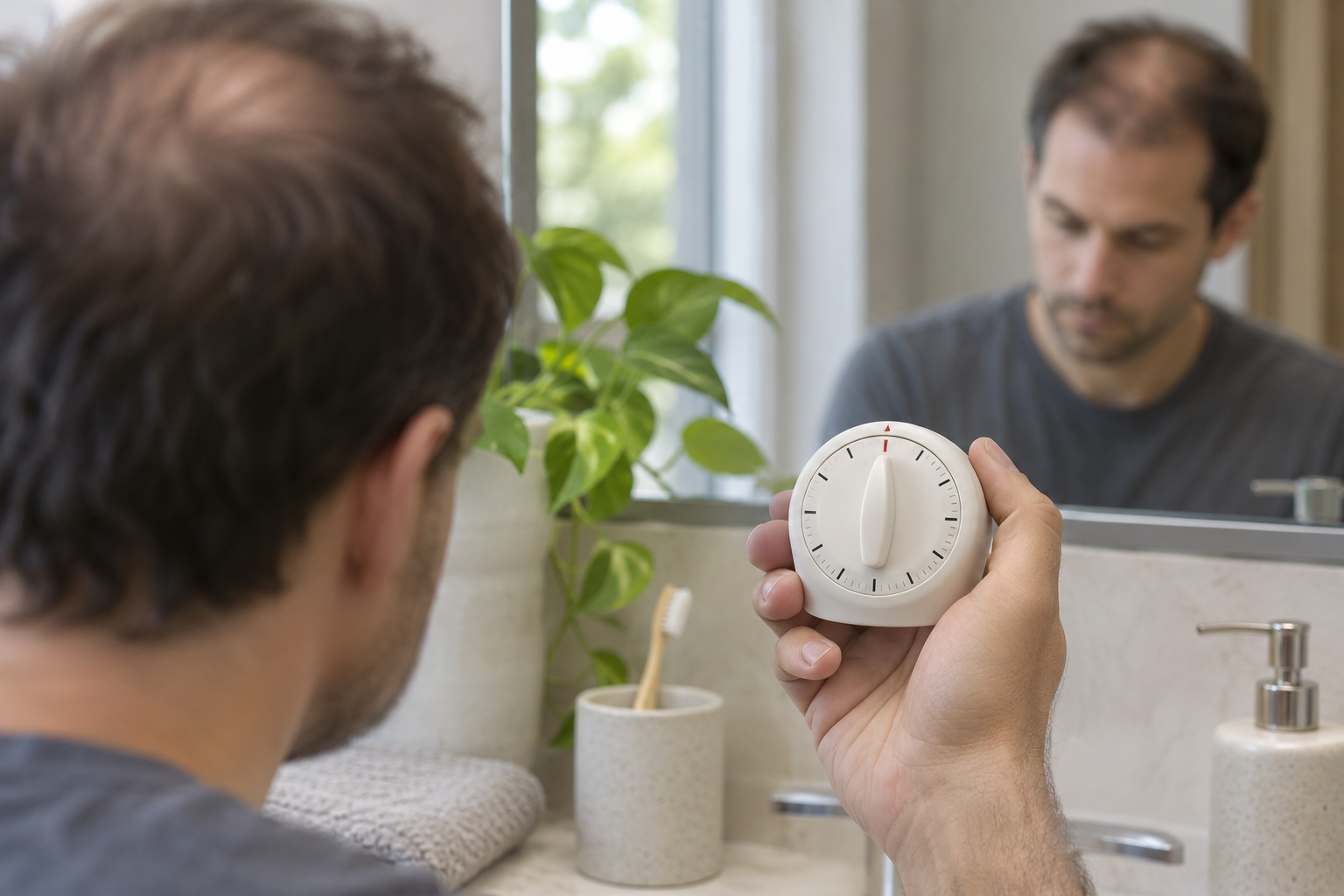
Separate three things when reviewing a product: the schedule used in its supporting trial, the current manufacturer’s instructions, and the time you can realistically commit. These may not be interchangeable.
The two research examples above used different protocols. Neither supplies a universal schedule for caps, helmets or combs. The AAD advises regular use according to the particular device’s directions and notes that results take time and do not occur for everyone.
Before buying, consider setup, charging, cleaning, storage and any hands-on movement the instructions require. A short session can still be inconvenient if it does not fit the times or places where you expect to use it. Ask to see the manual before making the purchase.
Follow that manual rather than increasing sessions or borrowing another model’s routine. Discuss expectations and reassessment with your clinician, especially if you already have a treatment plan.
A practical pre-purchase comparison
Use the following table to collect information from the manual, regulatory record, research paper and seller’s current terms. Blank answers are questions to resolve before paying, not details to fill with assumptions.
| Buyer question | What to verify | Why it matters |
|---|---|---|
| Does the model suit my situation? | Exact indications and clinician assessment | A product’s label and research may cover a narrower group. |
| How closely does the research match? | Studied model, comparison group, duration and sponsor | Category-level claims can hide differences between products. |
| Can I keep to the instructions? | Session frequency, length and handling requirements | The routine must be practical over time. |
| Will it fit comfortably? | Sizing guidance, fit assistance and try-on or return terms | Fit problems can make an otherwise appealing purchase impractical. |
| What could I lose on a return? | Return deadline, fees, shipping and required usage records | A refund promise may have important conditions. |
| What happens if it fails? | Warranty exclusions, battery service and repair process | Purchase price is only one part of ownership. |
Read the return terms before the headline price

Compare the ordinary listed price and the total checkout cost. Then read the return policy separately: when does the clock start, how do you request authorization, who pays postage, and are service or restocking fees deducted? Save the terms that apply to your order.
Check whether a trial period requires registration, photographs, minimum use or other records. A money-back headline is useful only if its conditions are clear and manageable. Financing also needs its own review of payment obligations and how a return affects the balance.
For a broader selection framework, see our first-time buyer’s guide to home hair-growth devices. Model-specific buying discussions include our iRESTORE Essential review, iRESTORE Professional review and Theradome PRO versus EVO comparison. Recheck the seller’s current terms before ordering.
Safety and other treatments
The AAD advises discussing light-sensitive conditions and photosensitizing medication with a dermatologist before home use. Follow the device’s eye-protection instructions; if protective goggles are required, ordinary sunglasses are not a substitute. Short-term research does not settle every long-term safety question.
A device should fit into a clinician’s plan rather than prompt you to change prescribed medication yourself. Ask how its use would be assessed alongside any existing treatment. This article does not establish that a device equals or replaces minoxidil, finasteride or another treatment.
Questions buyers often ask
Does red light therapy work for male pattern hair loss?
Controlled studies of certain devices have reported benefits in people with diagnosed pattern hair loss. That supports considering the relevant evidence, not promising a response from any product labeled “red light.” Match the study and indications to the exact model.
Is an LED device worse than a laser device?
The light-source label alone cannot answer the buying question. Ask for evidence relevant to the full device and its intended use. These research examples are not a head-to-head test proving that one category is universally better.
How long should I expect to use a device?
The examples discussed here ran for 24 and 26 weeks. Use the current model’s instructions and discuss reassessment with your clinician. A research endpoint is neither a deadline guaranteeing results nor permission to change the schedule.
Can I use a generic red lamp instead?
Do not assume that a lamp designed for another purpose reproduces a hair device’s labeling or clinical evidence. Ask what supports that exact product for scalp hair growth, and check its intended use before considering it a substitute.
What if I already use minoxidil or finasteride?
Bring the device information and instructions to the clinician managing your treatment. Do not start, stop or taper medication based on a product advertisement or this buying guide.
Before you buy
A worthwhile decision starts with a diagnosis and a realistic expectation of uncertainty. Identify the exact model, read its evidence and instructions, and write down the full purchase and return costs. If the seller cannot explain the connection between its claims and the product in your cart, resolve that gap before committing.
Sources and editorial scope
Sources checked November 23, 2026. This is an editorial evidence and purchasing guide, not a hands-on device test or a dermatologist-reviewed treatment recommendation. The Kim trial summary is based on its abstract; the Jimenez paper was reviewed in full text. No retail product is ranked from these studies.
- Kim et al., 2013: 24-week controlled trial (PubMed abstract).
- Jimenez et al., 2014: controlled LaserComb trials (full paper).
- American Academy of Dermatology: hair-loss diagnosis and treatment.
- American Academy of Dermatology: red light therapy overview and precautions.
- FDA: the 510(k) pathway and substantial equivalence.